
You already know the tax code. I’m not going to explain §168(k) to a room full of people who apply it for a living.
What I can tell you is the part that sits beside your analysis, and that’s the aviation side: how this industry actually operates, and the standards and practices your client’s structure will have to live inside. Whether the position you’re being asked to bless holds up can depend on operational facts most clients cannot describe accurately, and that almost never make it into the spreadsheet you get handed.
That’s the gap this article is about.
The conversation usually arrives too late
Here’s how it typically goes.
A client calls in the fourth quarter. They’ve been talking to someone about an aircraft. There’s an aircraft value, there’s a deadline they have to meet, and there’s a strong implication that a large first-year deduction is waiting if they move quickly. Nobody enjoys being rushed into a decision this size, and that’s exactly the position your client is in when they call. They want to know whether it works.
By the time that call happens, several decisions have already been made. An aircraft has been selected. A structure has been sketched by someone with an interest in the transaction closing. And your client is emotionally committed, which means you are no longer advising on a decision. You are being asked to validate one.
I get a version of that call every November. The tax work is usually fine. What nobody looked at is the airplane and whether it matches how this person actually travels. Is it the right size for the trips they take? Are the hour projections anywhere close to real? Will the structure somebody sketched out survive the way the client is going to fly it? Nobody asked, because nobody in the room knew enough about airplanes to ask.
That’s the part we want to help with. Our interest here is the same as yours: your client making a good decision. We’re not trying to work around you or past you, and the outcome is better when the aviation side and the advisory side are on the same page before anything gets signed.

What the deduction actually depends on
OBBBA was signed in July 2025. It brought 100% bonus depreciation back for qualifying property acquired and placed in service. Aircraft are part of that, and have been for years. The IRS reaffirmed the framework in Notice 2026-11 this past January.
You know all that. The part I’d emphasize is that the deduction has never been about the purchase. It’s about use.
You’ll be testing against the qualified business use threshold under §280F, the sub-test that comes into play when certain uses get counted toward it, the entertainment disallowance under §274, recapture if business use drops below the threshold in a later year, and state treatment, since plenty of states decouple from federal bonus depreciation. That’s your work and you don’t need my help with it.
Where you need help is that every one of those tests gets answered by operational and structural facts. Such as, who holds operational control? Which entity is on the registration? How does each individual trip get categorized, and by whom, including whether it counts as commercial activity or private activity? Is the structure producing an attractive hourly rate the same structure supporting the tax position, which it often isn’t?
Your client can’t answer those questions accurately. I’ve watched clients try. And the person selling the aircraft usually has no idea what your job actually involves. They’re working from things they’ve heard, or things somebody told them once, and passing it along in good faith.
The FAA and the IRS do not agree, and never have
This is the biggest takeaway for any advisor, because it causes more trouble than anything else on this list.
The FAA and the IRS are looking at the same airplane and asking completely different questions. Neither agency particularly cares what the other one wants.
The FAA cares about operational control. Who is really directing the flight, who has authority over the crew and the maintenance, and whether anybody is being carried for compensation or hire. That determines whether you’re operating under Part 91 or whether you need a Part 135 certificate, and the consequences for getting it wrong are not small.
The IRS does not care about any of that. Ask a revenue agent about Part 91 and you will get a blank look. It isn’t their statute and it isn’t their job. What they understand is business purpose, ownership, active versus passive, material participation, and whether the income and losses landed in a place where the taxpayer can actually use them.
So you end up with two regimes pointing at the same aircraft, and the structure that satisfies one can create a problem in the other.
The classic example is the sole purpose entity: a company formed to hold the airplane and nothing else. It’s a clean answer for a lot of reasons and clients like it. The problem is that, if it isn’t structured correctly, an entity whose only business is providing flights looks to the FAA like carrying people for compensation without a certificate. The FAA treats those arrangements as illegal charter operations, and there’s a long enforcement history behind that position.
There are ways to solve it. What the right one is depends entirely on the client’s circumstances, which is why I’m not going to lay out a template here. It’s a conversation, not a form.
Now flip it around. Build the structure to keep the FAA comfortable, park the aircraft in a leasing entity, and you can end up with the losses sitting in a passive bucket. Your client can’t use them against active income. The structure is fine. The airplane is fine. The deduction they were counting on isn’t doing anything for them.
I’m not going to work through how to resolve that in a blog post either. What I will say is that our team does this every day, and we’re glad to sit in on it. It has to be resolved deliberately, by people looking at both halves at the same time, before anything gets signed. What usually happens instead is that each side optimizes its own piece, nobody compares notes, and the incompatibility turns up eighteen months later when somebody finally asks a question.
The conflict nobody flags at the closing table
There’s a related one worth knowing about, and it shows up constantly.
A structure built to generate charter revenue on the aircraft and a structure built to support active tax treatment pull against each other. Putting an aircraft on somebody’s certificate to offset operating cost changes the operational control picture, changes how the use gets characterized, and can change the liability exposure. Both approaches are legitimate. Having both at once is difficult, though not impossible, and getting there takes deliberate design rather than luck.
This is where passive versus active becomes the whole conversation, and it’s the part I’d want an advisor watching most closely.
The moment an aircraft starts generating revenue for third parties, the activity around it starts to look like a rental or leasing activity. You know what that does to the loss characterization better than I do. What I can tell you from the aviation side is that the feature making it attractive operationally—which is that a professional operator handles the airplane and the client doesn’t have to think about it—is the same feature working against the material participation analysis. Your client isn’t running the flight department. That’s the whole point of the arrangement. It’s also the fact pattern you have to deal with.
So a client can end up in a structure that reduces their operating cost, generates real revenue, satisfies the FAA cleanly, and still produces losses they can’t use against the active income they were trying to shelter. Nothing about it is improper. It just doesn’t do the thing they bought it to do.
Which way your client should go depends on their tax position, their utilization, their appetite for risk, and honestly what they want out of the thing. That’s a decision you and the aviation side should make together, and it needs to be made before documents are executed. Unwinding it afterward is expensive.
Three principles worth borrowing
I work from three principles with every client. The first one tends to land with advisors, because it’s a discipline rather than a pitch.
One. Never put more capital into private aviation than the client can write off.
That’s a ceiling, not a reason to buy. Whether the client should be in aviation at all is a question their flying answers. How much capital belongs in the structure, once that’s settled, is a question you answer. It’s your number, not mine, and I’d want it before anybody starts looking at airplanes. It sizes the whole decision.
Two. Whatever capital goes in should be doing two jobs.
One is obvious: it buys the ownership interest, with whatever treatment properly attaches. The other one almost nobody builds for, which is that the capital should also be bringing down what each hour costs to fly. Most structures never get past the first job.
Three. The structure has to survive being looked at.
We don’t promise write-offs, and I get suspicious of anyone who does. We build structures that hold up under examination and we keep the records from day one, because assembling them later, under pressure, with a deadline, produces exactly the kind of file that invites more questions.
That third one is worth pressing on with clients who show up excited. A deduction you can’t substantiate isn’t a deduction. It’s an exposure with a delay on it.
The part nobody likes to say out loud
Aviation tax is a facts-and-circumstances area, and facts-and-circumstances areas produce inconsistent outcomes.
You know this better than I do. Two clients with similar structures, similar documentation and similar use patterns can land in different places depending on who examines the return and how much business aviation that examiner has seen. Aircraft are a niche. Not every agent who picks one up has worked many, and the ones who have don’t always agree with each other.
I bring it up because it changes what a good position even means.
If the outcomes were predictable, the game would be finding the line and standing as close to it as you can. They aren’t predictable. So the goal is different. You want a position that survives a bad examiner, not one that needs a good one.
Practically, that means keeping the records as you go. Reconstructed logs look reconstructed, and everybody recognizes one when they see it. On the genuinely close calls I’d take the conservative read, since close calls are where you’ll see the most variance from one examiner to the next. And I’d stay away from anything that only works if somebody reads an ambiguous provision in your client’s favor.
It applies to projections too, ours included. Our assessment produces preliminary estimates off stated assumptions. That’s useful for framing a decision. It isn’t a forecast of how an examination comes out, and we don’t pretend otherwise.
The clients who do well here are the ones who built something defensible and kept the records. The ones who have trouble are rarely the aggressive ones. They’re the ones with perfectly reasonable positions and nothing in the file to show for them.
What the Aviation Strategy Assessment gives you
We built the Aviation Strategy Assessment, and the Private Aviation Cost Calculator inside it, to pull that conversation forward and put it in a form you can actually work with.
A client completes it before selecting an aircraft. It works through travel requirements, expected utilization, mission profile, aircraft category, capital priorities, operating costs, tax objectives, flexibility, risk, and exit considerations. More than 250 variables can influence the outcome. The client doesn’t need to understand them. That’s our job.
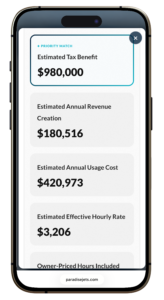
What comes out is a preliminary aviation strategy: which approaches are worth exploring, whether that’s charter, fractional ownership, whole aircraft ownership or some combination, with preliminary estimates on utilization, aircraft category, ownership requirements, annual costs, effective hourly economics, and tax-related considerations.
The output isn’t really the point for you. What matters is that you finally have something to tear apart.
Your client arrives with assumptions written down and the aviation reasoning visible, instead of a question about whether a deduction works. If the utilization number doesn’t square with what you know about their business, you’ll catch it. If the aircraft looks oversized for the trips they described, you’ll catch that too. And the proposed structure is sitting in front of you while there’s still time to change it.
That’s a different starting point than a brochure and a deadline.

Where fractional changes the analysis
Sometimes the answer is a fractional interest rather than a whole airplane.
This option rarely comes up in an advisor conversation, and usually for a simple reason: it isn’t on the list, because it’s either misunderstood or unknown. Plenty of very good advisors have never had a client go this route, so it doesn’t occur to them to ask about it, and what they do know about fractional tends to be a vague impression of buying hours on somebody else’s airplane. That isn’t what it is.
A fractional interest is ownership, and this trips up more people than you’d think. Smart professionals routinely miss that several entities can hold title to the same aircraft at the same time, each with its own owner and its own tax treatment. That isn’t an accident of the structure. It’s how we designed it, and it’s what lets one owner pursue a very different tax position than the owner of the share next to them.
Here’s the part that matters most for your work. From a tax standpoint, a fractional interest runs down substantially the same path as whole ownership. Your client owns depreciable property. The same tests apply, the same business use questions get asked, the same documentation is expected, and the same recapture exposure exists on disposition. What changes is the size of the check.
For a lot of clients that’s the entire appeal, and it connects directly back to the first principle. If you’ve told your client they can support a certain amount of capital, whole ownership frequently overshoots it by a wide margin. Fractional lets them deploy an amount that actually matches the number you gave them. They aren’t forced to buy more airplane than their tax position supports just to get into ownership at all.
That also puts a fractional interest in different territory than charter or a jet card, where your client is buying transportation rather than property.
The catch is that program terms vary enormously between providers. Annual allocation. What happens to hours the client doesn’t fly. Recurring fees. Operational control. Whether the interest can be transferred, and how the exit works. All of it moves the economics, and some of it will land in your analysis when the interest is eventually disposed of.
How we built JetShare, and why
JetShare is our fractional ownership program. It didn’t start as a product. It started as a list of complaints.
Consulting with clients year after year, we kept hitting the same problems across the industry. Management fees that accrued whether the airplane moved or not. Hourly rates that concealed more than they disclosed. Hours that vanished at year end. Exits nobody wanted to discuss until the owner was already trying to leave. Different providers, different aircraft, the same handful of structural failures showing up over and over.
So we built our own and engineered those out. Two features come up most often in conversations with advisors.
Unused hours. In most fractional programs, hours the owner doesn’t fly are gone at year end. We purchase some of those unused hours back and return the value as flight credit rather than cash. On a Lear 60 share, a light year can produce roughly $90,000 in flight credit toward future flying.
Exit. JetShare carries an 80% repurchase value under the ownership terms. What that means for you is that the disposition question already has an answer while your client is still deciding, rather than years later when they want out. If you’re running recapture numbers, a defined mechanism beats a residual value somebody guessed at.
Where the line sits between us
Let me be explicit about the division of labor, because it’s the whole basis for working together.
You determine tax treatment. Eligibility, timing, entity structure, substantiation standards, state treatment, recapture exposure, and how all of it fits the rest of the client’s position. We don’t opine on that. I don’t want to.
We determine whether the aviation structure makes sense. Whether the airplane fits the missions, whether the utilization assumption is realistic, whether the operating economics hold up, whether the operational structure supports what the client is actually trying to do, and what the exit really looks like.
It goes wrong in two directions. An aviation salesperson starts fielding tax questions he has no business answering. Or a CPA gets handed a set of aviation assumptions with no way to check a single one of them. I see both, regularly. Either way the client walks away thinking somebody verified the whole thing, and nobody did.
We’d rather be the aviation expertise sitting next to your analysis than a vendor handing your client a projection you never saw.
Give your client a better starting point
If a client is weighing charter, fractional ownership, or buying an aircraft, and especially if bonus depreciation is what’s creating the urgency, the aviation strategy should be settled before the tax analysis starts.
Have them complete the Assessment first and bring the results to you. Pick apart the assumptions. Tell us what doesn’t hold. We’ll work the aviation side alongside you.
And if the analysis says your client shouldn’t own an aircraft, we’ll say so. That happens more often than you’d expect from a company that sells them.
START THE AVIATION STRATEGY ASSESSMENT →
The Aviation Strategy Assessment provides preliminary estimates and strategic considerations based on information supplied by the user and applicable modeling assumptions. Paradise Jets does not provide legal, tax, accounting, investment, or financial planning advice. Tax treatment, including eligibility for bonus depreciation or other deductions, depends on individual circumstances and applicable law. Clients should consult their independent CPA, tax counsel, financial advisor, and other professional advisors before making aviation, financial, or tax decisions.